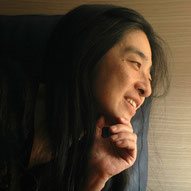
Keiko Fujiie was born in Kyoto in 1963. She is an award-winning composer whose music is frequently performed in Japan and around the world.
She graduated from the Tokyo National University of Fine Arts and Music and completed her postgraduate studies at the same institution.
She is one of a select few Japanese composers to have won the prestigious Otaka Prize twice, awarded by the NHK Symphony Orchestra for outstanding symphonic compositions. She won in 1995 for "Beber for Orchestra" and in 2000 for "Guitar Concerto No. 2 Koisucho."
She has composed numerous pieces for the guitar, many of which are dedicated to the renowned Japanese guitarist Kazuhito Yamashita, who was also her husband.
In 1996, Fujiie was presented with the Kenzo Nakajima Award for her monologue opera "Nina de Cera".
In 1992-93, she received a residency in New York through the Asian Cultural Council, and she returned in 1998 to premiere "In Their Shoes", a music and dance collaboration.
From 1998 to 1999, she served as the composer-in-residence for the Orchestra Ensemble Kanazawa.
Her commissions include the Academic Festival Overture for Kyoto University's centennial anniversary, the double concerto Kyoto: Reverberation, which was composed for the 1997 Kyoto Protocol Treaty, and Piano Concerto No. 1, Memories of January, which was composed for the 2001 Japan Music Competition's seventieth anniversary.
She was also asked to write the compulsory piece for the Fifth Musashino-Tokyo International Organ Competition in 2004, and At the Tomb of Fra Angelico for organ and orchestra was composed for the winner of the same competition in 2006.
Her Guitar Concerto No. 3, "Autumn Reverie," premiered in Seoul in 2011.
From 2001 to 2014, Fujiie's primary focus was organizing the guitar quintet Kazuhito Yamashita Family Quintet, for which she also composed.
Kasane, her work, was their main repertoire and typifies the music of a bygone era. The quintet drew inspiration from the Risorgimento and older musical traditions of Europe and Japan, when such music was widely known and valued. Echoes of this music can still be heard in the classic 11th-century Japanese novel The Tale of Genji.
In this piece, four guitars layered with shifting tonal colors represent the various plucked string instruments of old Japan.
Fujiie made three CDs with the Kazuhito Yamashita Family Quintet and was invited with them to many music festivals, including the Rome International Guitar Festival in 2004, the Córdoba Guitar Festival in 2007 and 2011, and the Open Guitar Festival in the Czech Republic in 2011.
Fujiie composes for orchestra and choir, and has written chamber music and opera. One of her areas of research interest is gagaku, the ancient court music of Japan. She also composes for gagaku ensembles.
In recent years, Fujiie has been passionate about composing operas. Since the end of 2019, he has been based in Burkina Faso in West Africa, where he is producing and composing a new opera "Là-bas ou ici..." in collaboration with the Griot people. The opera has already been performed several times in Burkina Faso and at the Osaka Kansai Expo in August 2025. During this time, she also premiered another opera, for which she wrote the libretto, "A Vermilion Calm," in Poland in 2020 and in Germany in 2021.
In 2024, she composed new music for the Nenkuyo-eshiki, a ritual performed for over 1,000 years at Taimadera Temple, one of Japan's oldest. The music was recorded in Japan, Taiwan, and Hong Kong, and it was presented at the ceremony in April 2025.